Are Weight Loss Supplements Effective? Spotting Industry-Funded Studies Behind the Marketing
Quick answer: are weight loss supplements effective, or is it the funding talking?
Much of the research quoted in supplement marketing was paid for by a company with a commercial stake in the answer, and studies funded that way are more likely to report conclusions favourable to the sponsor. That does not make the findings false — it means you should read the methods harder and check the funding line before treating a claim as settled. The funding statement is public, it takes about a minute to find, and it changes how much weight a single study deserves.
- Where to look: the Funding, Acknowledgements or Conflicts of Interest section at the end of the paper.
- What it means: a reason for extra scrutiny, not automatic dismissal.
- The bigger tell: a claim that grew louder with every retelling between the journal and the sales page.
What "industry-funded" actually means
Sponsorship in nutrition research is not usually a brown envelope. It is ordinary and mostly above board: a company pays a university group or a contract research organisation to run a trial on its ingredient, because nobody else has a reason to. Public funding for supplement research is scarce, so if a trial exists at all there is a good chance a manufacturer paid for it. The alternative to industry-funded research in this field is frequently no research whatsoever.
The influence, where it exists, comes in through design choices rather than fabricated numbers. Who gets to choose the comparison group, the dose, the duration, the population, the primary outcome, and whether a disappointing result ever reaches a journal at all? Each of those decisions is defensible in isolation, and each one nudges the odds. Stack a few of them and you can produce an entirely honest study that was always likely to come out well.
Research on research — the field that studies how studies behave — has looked at this repeatedly across pharmaceuticals, food and supplements. The consistent finding is that sponsored work reports sponsor-favourable conclusions more often than independently funded work on the same questions. The mechanism is design and publication, not dishonesty, which is precisely why reading the methods is the correct response.
Where the funding statement hides
Journals require disclosure, but they do not make it prominent. In a typical paper the relevant text sits after the discussion, under one of four headings: Funding, Acknowledgements, Conflicts of Interest, or Author Disclosures. It is often a single sentence and easy to skim past.
Three phrasings are worth learning to recognise. "This study was supported by an unrestricted grant from" means the company paid and says it had no say — better than nothing, and impossible to verify. "The sponsor participated in study design, data analysis and manuscript preparation" is a full disclosure of deep involvement and is genuinely useful information. "The authors declare no conflict of interest," appearing directly beneath an author list where two people share an employer with the product manufacturer, is a disclosure that has failed.
Also check the supply line. Papers frequently note that the test product and matching placebo were "provided by" a named company. That is a material relationship even when no cash changed hands, because whoever supplies the capsules controls what is in them and what is in the placebo.
The question is never simply who paid. It is which decisions they were in the room for — and papers that answer that question honestly are usually the ones worth trusting.
Signals worth checking, and what each one is worth
No single flag settles anything. The pattern does. Here is how we weigh the common signals when a page claims research support for an ingredient.
| Signal | Where to find it | How much it should move you |
|---|---|---|
| Manufacturer funded the trial | Funding statement, end of paper | Moderate — read the methods closely |
| Sponsor involved in analysis or writing | Conflict of interest statement | High — the strongest single flag |
| An author is employed by the brand | Author affiliations, first page | High |
| Product and placebo supplied by the brand | Methods, materials subsection | Low to moderate — common and usually disclosed |
| Result never replicated independently | Search the ingredient on PubMed | High — replication is the real test |
| Study dose far above the label dose | Methods versus Supplement Facts panel | High — the claim may not apply to the product |
| Published in a journal with no visible editorial standards | Journal home page and indexing status | Moderate to high |
| Cited only as a press release, with no paper | The citation itself | Very high — treat as advertising |
Ask the plain question — are weight loss supplements effective — and you will find most of the marketing answer resting on rows one, five and six of that table at once: a sponsored trial, never replicated, at a dose the product does not supply. The bottom two rows carry the most weight in practice. An unreplicated finding in an obscure venue, cited without a link to anything you can open, is the modal citation in supplement marketing, and it is the one you can dismiss fastest.
Check the panel yourself
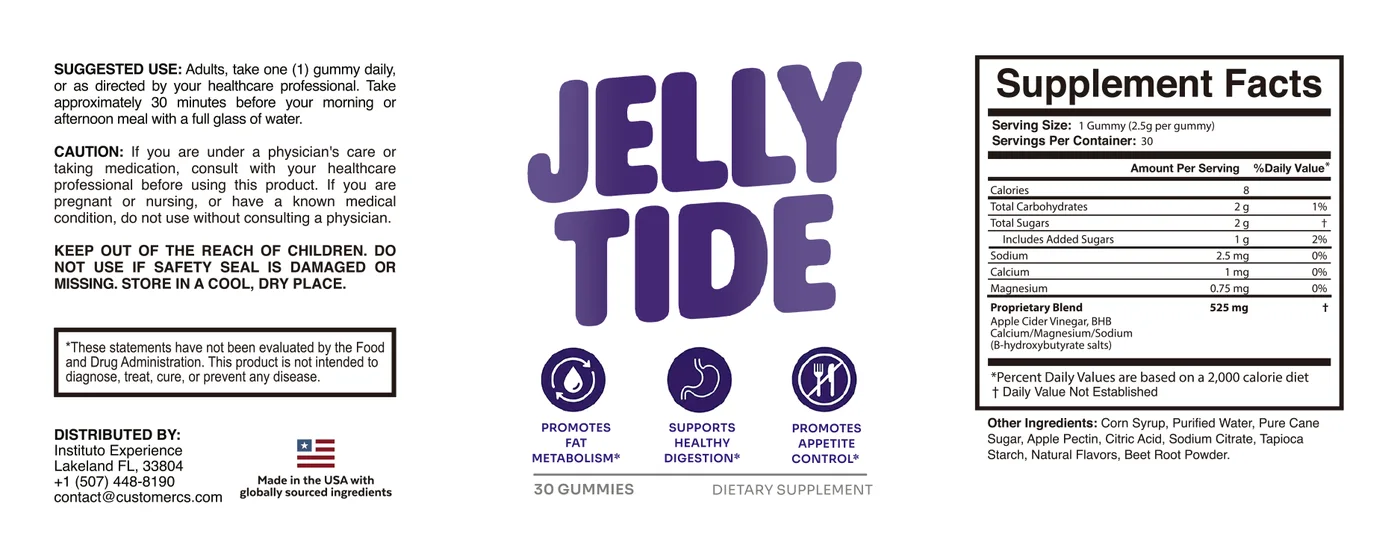
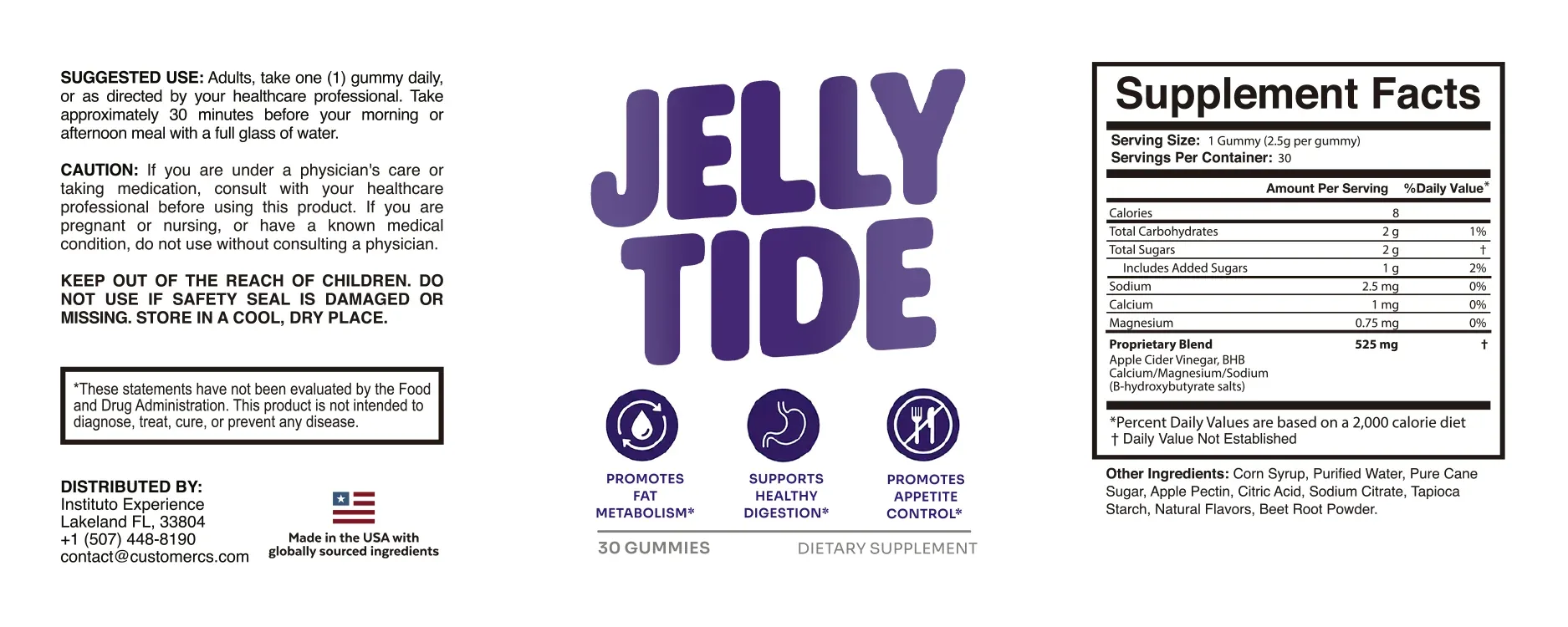
The one thing no marketing page can obscure is the amount per serving. We publish the full JellyTide Supplement Facts panel so you can compare it against the doses used in the literature before you commit to anything. Current bundles and terms — along with the only accurate apple cider vinegar gummies price — sit on the manufacturer's own page.
See the official offer pageHow a cautious finding becomes a bold claim
Watch a claim travel and you can see it gain confidence at every hop, without anyone lying outright.
Stage one, the paper. "Supplementation was associated with a modest reduction in body weight compared with placebo; the difference did not reach statistical significance for the primary outcome, and larger trials are needed."
Stage two, the university press release. "New research links the ingredient to reduced body weight." The hedges are gone, because press releases are written to be picked up.
Stage three, the aggregator. "Study finds ingredient reduces body weight." A verb has quietly changed from "linked to" to "reduces."
Stage four, the sales page. "Clinically proven to reduce body weight." Nothing in the original sentence survives except the noun.
This is why "clinically proven" is close to meaningless in supplement copy. It has no regulatory definition, no minimum evidence threshold, and no requirement that the study used the same dose, the same formulation or the same population as the product being sold. When a page tells you a formula is clinically proven, the only useful response is to ask for the citation and open it.
Ghost citations and the dose mismatch
Two specific failures account for most overstated ingredient claims, and both are quick to catch.
The first is the ghost citation: a superscript number, a bracketed reference, or a line reading "as shown in clinical research," attached to no title, no author, no year and no link. Sometimes the reference list at the bottom of the page cites a paper that turns out to be about a different population, a different formulation, or a different outcome entirely. Occasionally it is real and simply does not say what the sentence above it claims.
The second is the dose mismatch, and it is more common than outright misquotation. A study uses a gram of an extract daily; the product supplies a fraction of that inside a proprietary blend whose split is not disclosed. The research is legitimate. The citation is accurate. The claim still does not transfer to the product, because the amount is not there. Whenever a label shows a blend total rather than individual amounts, the dose comparison has been made impossible on purpose.
This is exactly why we do the arithmetic out loud on our JellyTide ingredient page, working through how much of the 525 mg blend can plausibly be ketone salt once the apple cider vinegar content is accounted for. It is a less exciting way to present a product than a claim about being clinically proven, and it is the only version a reader can check.
What funding does not tell you
It is worth being just as strict in the other direction, because "industry-funded" has become a lazy way to dismiss anything inconvenient. The broader question — are weight loss supplements effective — is not answered by a funding statement. A funding statement only tells you how much one citation is worth.
Funding does not prove bias in a specific paper. A sponsored trial that pre-registers its outcome, uses an adequate sample, analyses by intention to treat and publishes a null result is better evidence than an independent study that does none of those things. Method beats provenance every time.
Nor does the absence of industry money make a study good. Plenty of independent nutrition research is small, unblinded, based on food-frequency questionnaires, or fishing across dozens of outcomes until one turns up significant. Academic careers have incentives too, and a striking result publishes more easily than a boring one regardless of who paid.
And funding tells you nothing at all about safety, manufacturing quality or whether the capsule contains what the label says. Those are separate questions answered by third-party testing, by the manufacturing standard, and by whether a company will show you a certificate of analysis when asked. So the honest limit of this whole exercise is narrow: checking the funding tells you how much confidence a single efficacy claim deserves. It does not tell you whether to take the product, and no article can — these are dietary supplements, not treatments, and nothing here diagnoses, treats, cures or prevents any condition.
A five-minute audit you can actually run
When a page tells you a supplement is backed by research, this is the fastest way to find out what that means.
One: get the citation. If there isn't one, you are finished — the claim is advertising and can be treated as such.
Two: search the title on PubMed. The abstract is free even when the full text is not, and it carries the sample size, the duration and the primary outcome.
Three: check the numbers against the claim. Between-group difference, not the arm total. This is the trap we unpack in effect sizes against placebo, put in context.
Four: scroll to the funding statement. One sentence, at the end, and it takes ten seconds once you know where to look.
Five: compare the study dose with the label. If the label hides the split behind a blend total, note that the comparison cannot be made and weight the claim accordingly.
Run that on any shortlist and it will separate the plausible from the promotional quickly. It is also the reason we are wary of ranking anything as the best weight loss supplement outright: the ingredient evidence in this category is mostly low certainty, and a ranking implies a precision the literature does not have. Anecdotes have the same problem in a different shape, which is the subject of our piece on reading forum supplement anecdotes without fooling yourself. If you have run the checks and still want to compare formats, the searches worth making are for the panel and the return terms — not for where to buy keto gummies at the lowest headline figure.

Medical note: this article is general wellness information, not medical advice, and it summarises published evidence rather than making a product claim. JellyTide is a dietary supplement, not a drug, and is not intended to diagnose, treat, cure or prevent any disease. Speak to a healthcare professional before starting any supplement, especially if you are pregnant, nursing or taking medication.
Frequently asked questions
Where do I find who funded a study?
Look for a section headed Funding, Acknowledgements, Conflicts of Interest or Author Disclosures. It usually sits at the very end of the paper, after the discussion and before the reference list, and it is often one sentence long.
Does industry funding make a study wrong?
No. A sponsored trial can be well designed and honestly reported. What research on research shows is that sponsored nutrition studies are more likely to reach conclusions favourable to the sponsor, so funding is a reason to read the methods harder, not a reason to discard the paper.
What is citation laundering in supplement marketing?
It is when a cautious finding passes through a press release, then a news aggregator, then a sales page, gaining certainty at each step. The final claim often bears little resemblance to the study, and the only fix is to open the original paper.
How can I check a supplement claim in five minutes?
Search the study title on PubMed, read the abstract for sample size and duration, scroll to the funding statement, then compare the dose used in the study with the amount on the product label. Those four checks catch most overstated claims.
Sources
- PubMed — literature on research sponsorship and reported outcomes
- NIH Office of Dietary Supplements — ingredient fact sheets for health professionals
- NCCIH, National Institutes of Health — knowing when research is trustworthy
- Harvard T.H. Chan School of Public Health — interpreting nutrition research in the media
- Mayo Clinic — dietary supplements: what to know before you buy
Start with the label, not the claim
Every check in this article ends at the same place: the amount per serving. The JellyTide panel is transcribed and photographed on our home page, and the manufacturer's page carries the live bundle options, shipping and guarantee window.
Check the current offer