How to Spot Fake Weight Loss Reviews: A Field Guide to Paid, AI and Incentivised Testimonials
Quick answer: how do you spot fake weight loss reviews?
Spot fake weight loss reviews by looking for repeated phrasing, extreme before-and-after claims, undisclosed affiliate links and a suspicious absence of anything negative. Authentic reviews name specific details, describe ordinary results over realistic timeframes, carry verified-purchase tags, and include the occasional honest complaint.
- Fakery tells: identical wording, same-day clusters, only-five-star ratings, dramatic photos.
- Authenticity tells: specific detail, mixed ratings, verified purchase, a mild gripe.
- Follow the money: check whether the reviewer discloses a commission before you trust the verdict.

Why fake weight loss reviews are so common
Weight loss is one of the most lucrative categories on the internet, and where money pools, so do fake reviews. The incentives are brutal: a single convincing testimonial can move thousands of dollars in sales, so there is a whole cottage industry devoted to manufacturing them. Some are written by paid freelancers who never touched the product. Some are spun out by AI in bulk and lightly reworded. Some are real customers nudged into a five-star rating with a discount or a free bottle. And some are outright stolen — a stock photo and a fabricated name stitched together on a landing page. Learning to spot fake weight loss reviews is not cynicism; it is basic financial self-defence in a category built to separate anxious people from their money.
The good news is that fakery leaves fingerprints. Once you know the patterns, you cannot unsee them, and a review section that once looked persuasive starts to look like exactly what it is. This guide walks through the tells one at a time, then flips it around and shows you what genuine feedback actually looks like, so you are not left distrusting everything.
Tell one: the phrasing repeats
The single most reliable signal of fake weight loss reviews is language that repeats. Paid and AI-generated testimonials are produced at scale, and scale breeds sameness. You will see the same emotional arc ("I had given up hope, then I found this"), the same suspiciously brand-perfect vocabulary, and sometimes the same exact sentences across supposedly independent reviews on different sites. Copy a distinctive phrase from a glowing review and paste it into a search engine in quotation marks. If it shows up verbatim on five other product pages, you have found a template, not a customer.
AI-written reviews have their own accent. They are grammatically flawless, weirdly balanced, and strangely generic — lots of "this product has genuinely changed my relationship with food" and almost no concrete, checkable detail. Real people are messier. They misspell things, wander off topic, mention their dog, and complain about the packaging. Polish, counterintuitively, is a warning sign.
Tell two: the before-and-after photos do too much
Dramatic before-and-after images are the beating heart of weight-loss marketing, and they are the easiest element to fake. The same body can look thirty pounds different across two photos taken the same afternoon with a change of posture, lighting, tan and camera angle. Worse, stock and purchased "transformation" photos circulate across dozens of unrelated products — the same woman is losing weight for a keto pill, a tea, and a waist trainer, all at once, on three different sites. A photo can never show causation, duration, or even that the same person appears in both frames. Treat every before-and-after as advertising and weight it at zero.
This is exactly why we publish no customer photos or testimonials on this site at all. It is also why realistic expectations matter more than dramatic images: our guide to what realistic weight loss actually looks like month by month gives you a yardstick, so a fantasy transformation photo reads as the fantasy it is.
Judge the label, not the testimonials
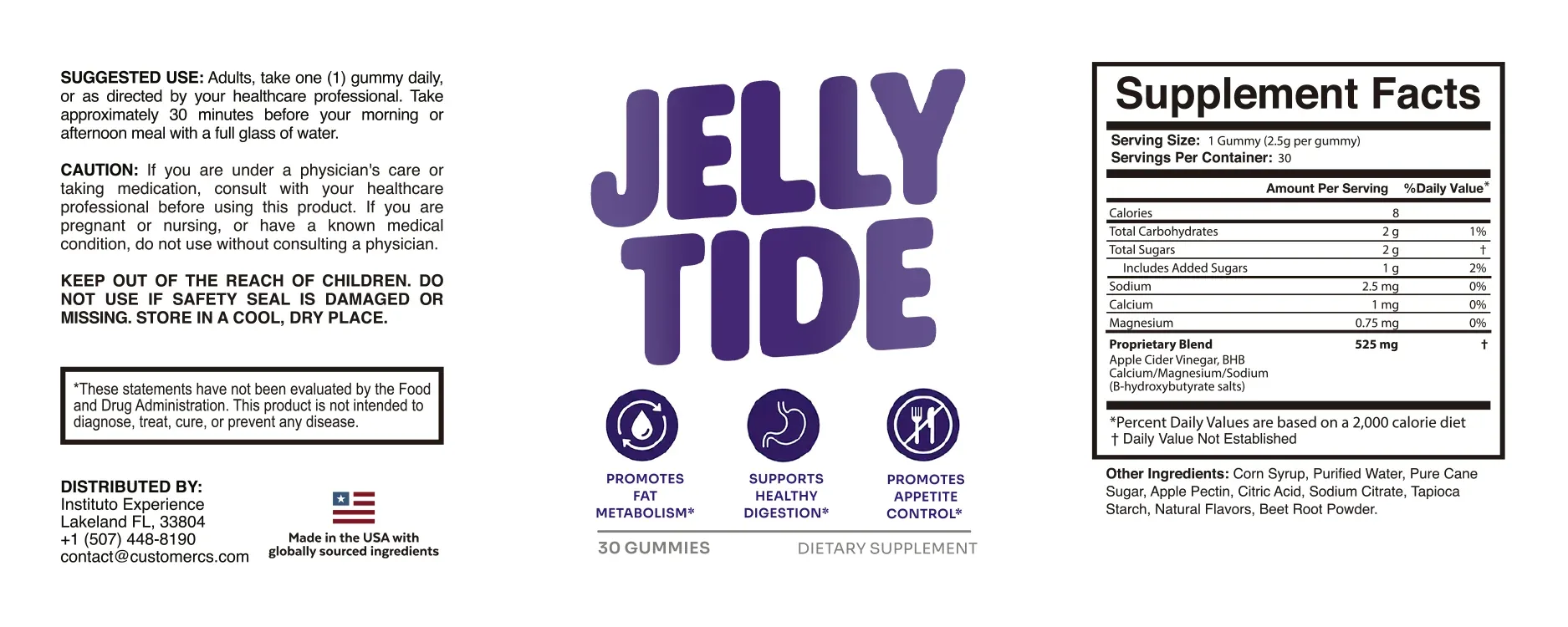
The most review-proof way to evaluate a supplement is to skip the testimonials and read the Supplement Facts panel. JellyTide is an apple cider vinegar and BHB gummy that publishes its full panel, so you can judge the doses yourself — no star ratings required. Current bundles and terms are only accurate on the manufacturer's own page.
See the official offer pageTell three: nothing negative, ever
Real products disappoint someone. That is not a flaw in the product; it is a fact about human variation. A supplement that genuinely helped a thousand people also did nothing for a few hundred, upset a couple of stomachs, and arrived late to somebody's door. So a review section that is an unbroken wall of five stars is not a triumph — it is a filter. Either negative reviews are being deleted, or only happy customers are being invited to write, or the whole section is seeded. The most trustworthy pattern is a strong average with a visible, honest minority of three- and four-star critiques that engage with the product's real limits.
Pay attention to how the brand handles criticism, too. A company that responds to a lukewarm review with a specific, human reply is behaving very differently from one whose entire feed is frictionless praise. Friction is a sign of reality.

Tell four: the affiliate link is hidden
Follow the money and most fake weight loss reviews explain themselves. A reviewer who earns a commission on every sale has a direct financial reason to accentuate the positives and bury the negatives. That does not make every affiliate honest or every affiliate review worthless — disclosure is the dividing line. An honest publisher tells you plainly that it may earn a commission, the way this page does in its footer. A dishonest one dresses a sales funnel up as a neutral "unbiased review" while quietly collecting a cut of every click. Before you weight anyone's verdict, look for the disclosure. If it is missing, assume the incentive is there and read accordingly.
The same logic applies to "top ten" ranking sites and comparison tables. Ask who owns the site and who profits from the number-one pick. Very often the ranking is simply a map of which brand pays the biggest commission, dressed up as objective research. The pattern of industry money quietly shaping "independent" verdicts is one we take apart in our look at whether weight loss supplements are worth the money once you strip out the marketing.
Tell five: the timing is suspicious
Reviews arrive in the rhythm of real life — a trickle, spread across weeks and months. A sudden cluster of glowing five-star reviews all posted within a day or two, often just after a product launch or a bad press cycle, is a classic seeding signature. Sort the reviews by date and watch the distribution. Bursts are bought. A slow, uneven drip is what organic feedback looks like.
Account age and history help too, where you can see them. A reviewer whose only ever contribution is a rapturous paragraph about one supplement is a weaker signal than someone with a long, varied history of reviewing unrelated things, including the odd critical one. One-and-done accounts are cheap to manufacture.
What a genuine review actually looks like
It is easy to end up distrusting everything, which is its own kind of failure. So here is the flip side — the marks of authenticity, so you can give credit where it is due. Genuine reviews are specific. They mention a concrete detail: how the gummy tasted, that they took it before lunch, that week two was when the snacking eased off, that the bottle was smaller than expected. They describe ordinary results over realistic timeframes — "a few pounds over a couple of months alongside walking more," not "twenty pounds in two weeks without changing anything." They frequently include a mild complaint, because real satisfaction is rarely total. And where the platform supports it, they carry a verified-purchase tag, which is not proof but is a meaningful filter.
Most of all, an honest ecosystem of reviews disagrees with itself. Some people loved it, some shrugged, one person's stomach did not get along with it. That spread is not weakness. It is the texture of truth, and it is precisely what a manufactured review section lacks.
A sixty-second checklist you can actually use
You do not need forensic skills to triage a review section before buying. Run these six checks and you will filter out most of the noise. One: paste a distinctive sentence into a search engine and see if it is a template. Two: sort by date and look for suspicious clusters. Three: read the one-, two- and three-star reviews first — the critical ones are where the truth usually lives. Four: check whether before-and-after photos appear elsewhere with a reverse image search. Five: look for a clear affiliate disclosure and factor the incentive in. Six — and this is the one that beats all the others — ignore the reviews entirely and go read the Supplement Facts panel, because the label cannot be faked the way a testimonial can. If you want to see what that looks like in practice, our transcription of the JellyTide apple cider vinegar and BHB gummy label does the arithmetic on the actual amounts per serving.
Medical note: this article is general consumer and wellness information, not medical advice, and it does not make a product claim. JellyTide is a dietary supplement, not a drug, and is not intended to diagnose, treat, cure or prevent any disease. Speak to a healthcare professional before starting any supplement, especially if you are pregnant, nursing or taking medication.
Frequently asked questions
How do you spot a fake supplement review?
Look for reviews that are long on emotion and short on specifics, repeat phrasing you can find on other listings, appear in a cluster on the same day, and never mention a downside. Genuine reviews tend to name a concrete detail, describe an ordinary result over a realistic timeframe, and often include a mild complaint. A verified-purchase tag and a mix of star ratings are reassuring signals.
Are before-and-after photos reliable?
Rarely, on their own. Before-and-after photos are easy to stage with lighting, posture, tan and a few weeks apart, and stock or purchased images circulate across many unrelated products. Treat them as advertising, not evidence. A photo can never show what caused a change, how long it took, or whether the same person is in both frames.
Do affiliate links bias reviews?
They can. A reviewer who earns a commission on every sale has a financial reason to emphasise the positives and downplay the negatives. That does not make every affiliate review dishonest, but undisclosed commissions are a red flag, and honest publishers state the relationship plainly. Always check whether the reviewer discloses how they are paid before weighting their verdict.
Can you trust five-star-only products?
Be wary. A product with nothing but perfect ratings is less trustworthy than one with a realistic spread, because real customers disagree and real products disappoint someone. An unbroken wall of five stars usually means reviews are filtered, incentivised or seeded. The most credible pattern is a strong average with a visible minority of honest three- and four-star critiques.
Related reading
Sources
- Federal Trade Commission — guidance on fake and deceptive online reviews
- FTC — Endorsement Guides and disclosure of paid reviews
- NIH Office of Dietary Supplements — Dietary Supplements for Weight Loss
- Mayo Clinic — weight loss: setting realistic goals
- Harvard T.H. Chan School of Public Health — Healthy Weight
Skip the reviews, read the panel
Once you know how to spot fake weight loss reviews, the logical next move is to stop relying on them altogether and judge the label instead. The JellyTide Supplement Facts panel is reproduced on our home page; current bundles, shipping and the guarantee window live on the manufacturer's own page.
Check the current offer